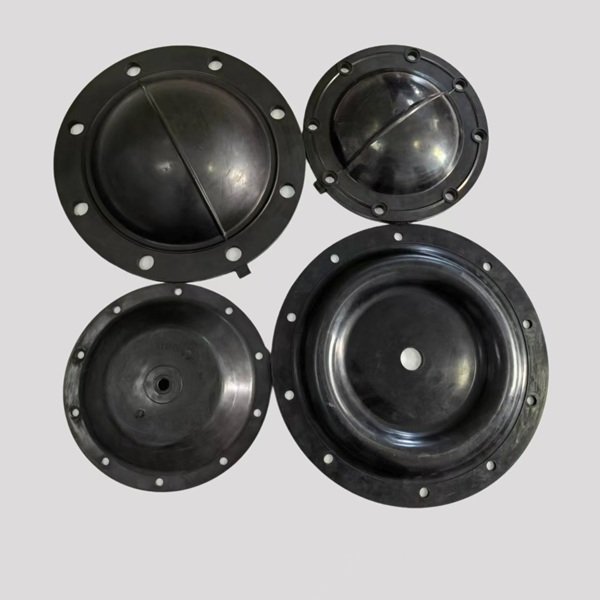
Item No. RD-008
A diaphragm is a simple idea executed with precision: a flexible membrane that separates, seals, and regulates — without leaking, sticking, or wearing out. We manufacture these components for industries where that precision is non-negotiable: automotive, aerospace, medical devices, fluid control, and heavy industrial machinery.
Each diaphragm starts with carefully selected elastomers and, where needed, fabric reinforcement for added strength. Advanced molding processes then shape it to tight tolerances. The outcome is a component that holds its seal through millions of flex cycles, resists aggressive chemicals and temperature swings, and can be produced to standard or fully custom specifications.
Carefully selected elastomers – NBR, EPDM, silicone, FKM, neoprene, natural rubber
Fabric reinforcement available – polyester, nylon, or aramid for high-pressure duty
Precision molding – tight dimensional tolerances, batch-to-batch consistency
Reliable sealing – effective barrier against gases and liquids
Stable pressure response – consistent regulation across wide pressure ranges
Chemical & thermal resistance – engineered for aggressive media and extreme heat or cold
High flex fatigue resistance – designed for millions of operating cycles
Multiple profile options – flat, convoluted, rolling, dished, and custom shapes
Sanitary grades available – food-grade and medical-grade compounds
Made to order – size, profile, material, reinforcement
Seals Tight, Stays Tight – Creates a leak-tight barrier between media and mechanical parts, keeping critical systems safe and efficient.
Pressure Control You Can Rely On – Uniform flex response and precise molding deliver stable regulation as operating conditions change.
Built for Millions of Cycles – Withstands repeated flexing without cracking or losing performance, reducing maintenance frequency.
Handles Aggressive Media – Multiple elastomer options cover aggressive chemicals, extreme temperatures, and harsh environments.
Automotive – fuel pressure regulators, brake systems, EGR valves, turbo wastegates
Aerospace – cabin pressure control, fuel systems, hydraulic actuators
Industrial machinery – pumps, compressors, valves, pneumatic actuators
Medical devices – ventilators, infusion pumps, blood pressure monitors, dialysis equipment
Fluid control systems – diaphragm valves, pressure switches, flow regulators
Water treatment – dosing pumps, filtration systems, chemical injection
Material
EPDM, NR, NBR, CR, FKM
Hardness
40-80ShA
Fabric
Polyester, nylon, curtain fabric, etc.
The general water pressure
0.4 MPa to 1.6 MPa
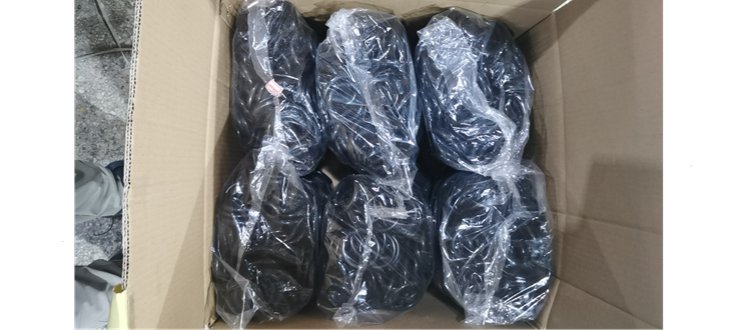
Standard: Goods are typically supplied in about 20-25kg/carton.
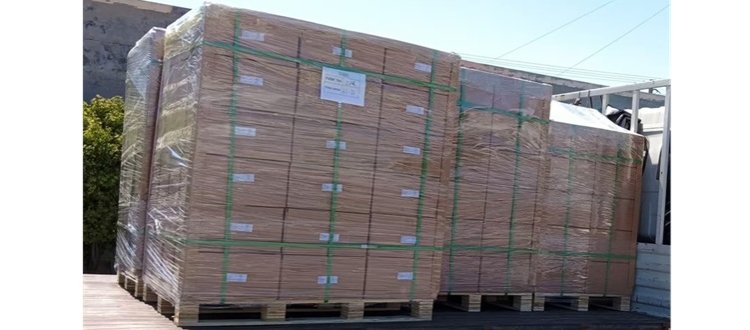
Standardized Pallets: Goods are stacked on heat-treated (ISPM 15) or plastic pallets, optimized for forklift handling. Rigid Corner Protectors: High-impact cardboard corner guards are applied to the full height of the stack. This prevents the straps from cutting into the rubber and maintains the vertical integrity of the pallet.
What materials are available for rubber diaphragms?
NBR, EPDM, silicone, FKM (Viton®), neoprene, natural rubber, and custom compounds.
What is the difference between fabric-reinforced and non-reinforced diaphragms?
Fabric-reinforced diaphragms offer higher pressure resistance, longer stroke, and better dimensional stability. Non-reinforced types are more flexible for lower-pressure applications.
What temperature range can rubber diaphragms withstand?
NBR (-30°C to +110°C), EPDM (-50°C to +150°C), Silicone (-60°C to +230°C), FKM (-20°C to +230°C).
How many cycles can a diaphragm last?
With proper material and design, millions of flex cycles. Life depends on pressure, stroke, temperature, and media.
Can you produce custom diaphragm profiles?
Yes. Flat, convoluted, rolling, dished, and fully custom profiles to your drawings or samples.
Are food-grade and medical-grade diaphragms available?
Yes. FDA-compliant food-grade and medical-grade silicone and EPDM compounds are available.
What is the typical lead time?
Standard designs often ship within 7–15 working days. Custom orders typically 15–25 working days.
Do you offer prototyping?
Yes. Rapid prototyping is available to verify fit and performance before full production.
If you have any questions or needs about the product, please fill in the following form and we wll contact you as soon as possible.
PHONE: +86 0532 8769 9025
EMAIL: sales@todorubber.com
Located in Jimo
Located in Xinhe


