
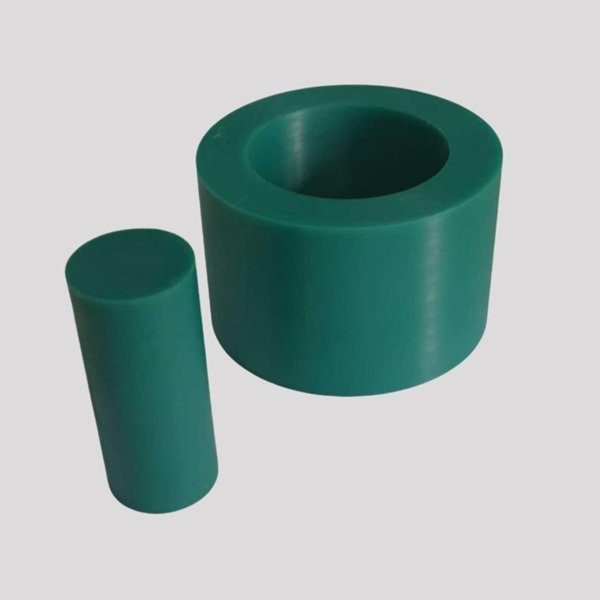
Item No. PP-007
Cast polyurethane is a remarkable material: it flexes like rubber, but holds its shape under loads that would destroy rubber in weeks. Our PU parts take full advantage of this — serving as bushings, rollers, pads, and custom components that cushion impact, absorb vibration, and control movement between connected parts.
Where rubber softens, swells, or tears, polyurethane keeps working. Higher stiffness. Far better wear resistance. Reliable performance in oily, abrasive, and heavy-duty conditions. That is why our PU parts are trusted in vehicle suspension systems, engineering machinery, and mining equipment around the world.
Cast polyurethane construction – durable, elastic, dimensionally stable
Higher stiffness than rubber – better load-bearing, tighter motion control
Superior wear resistance – outlasts rubber 2–5 times in friction applications
Excellent tear & abrasion resistance – resists chunking, cutting, edge wear
Effective vibration & impact damping – cushions shock between moving parts
Oil, grease & chemical tolerant – thrives where rubber would degrade
Wide hardness range – 60 Shore A to 60 Shore D, tunable per application
Multiple product forms – bushings, rollers, pads, sleeves, custom shapes
Bonded metal inserts optional – secure mounting, precise fitment
Made to order – any size, shape, hardness, and color
Stiffer Than Rubber, Still Elastic – PU carries heavier loads with less deflection, sharpening alignment and handling precision in suspension and linkage systems.
Wear Life Measured in Years, Not Months – In high-friction service, PU outlasts rubber by 2 to 5 times, slashing replacement frequency and downtime.
Resists What Destroys Rubber – Oils, greases, abrasion, tearing, and edge loading — polyurethane handles them all without swelling, chunking, or failing.
Tighter Motion Control – Limits unwanted play and deflection while still damping vibration, delivering more predictable, repeatable performance.
Tunable Hardness – From 60 Shore A (flexible, vibration-focused) to 60 Shore D (rigid, high-load), each part is tuned to its specific job.
Vehicle suspension – control arms, tie rods, rocker arms, sway bars
Engineering machinery – excavators, loaders, cranes, drilling rigs
Mining equipment – crushers, screens, conveyor parts, wear pads
Material handling – forklifts, conveyors, lifting equipment
Industrial machinery – pivot points, hinge joints, linkage components
Agricultural equipment – tractor linkages, implement pivots, hitch parts
Material
Polyurethane (PU)
Features
Wear resistant, abrasion resistant, tear resistant, high load capacity, oil resistant, vibration damping
Hardness
Custom Shore hardness available
Application
Automotive, general machinery, industrial equipment, specialty machinery
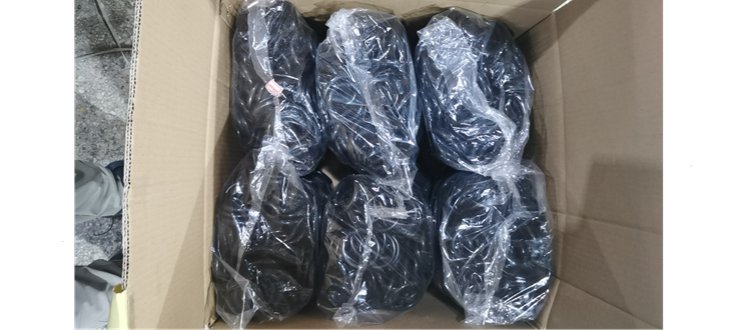
Standard: Goods are typically supplied in about 20-25kg/carton.
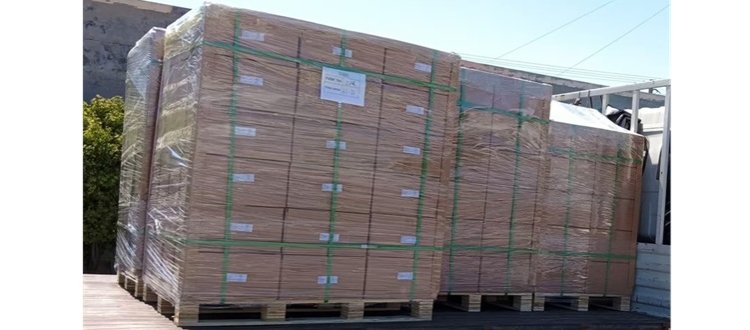
Standardized Pallets: Goods are stacked on heat-treated (ISPM 15) or plastic pallets, optimized for forklift handling. Rigid Corner Protectors: High-impact cardboard corner guards are applied to the full height of the stack. This prevents the straps from cutting into the rubber and maintains the vertical integrity of the pallet.
What exactly are PU parts?
Components cast from polyurethane — a material that flexes like rubber but delivers far higher stiffness, wear resistance, and load capacity. Common forms include bushings, rollers, pads, and custom profiles.
How do PU parts compare to rubber parts?
PU is stiffer, far more wear-resistant, and handles heavier loads. Rubber is softer and better at isolating high-frequency vibration. For high-load, high-friction work, PU wins.
What hardness can you produce?
From 60 Shore A (flexible) to 60 Shore D (rigid). We tune hardness to match your load, vibration, and wear requirements.
What forms do you manufacture?
Bushings, rollers, pads, sleeves, and fully custom profiles — all cast to your specifications.
Can PU parts handle vehicle suspension duties?
Yes. They are widely used in control arms, tie rods, and rocker arms, delivering sharper handling and longer life than rubber.
Will PU parts make my equipment noisier?
PU transmits slightly more high-frequency vibration than soft rubber, but damps impact and low-frequency vibration well. Hardness choice balances control against comfort.
Are they resistant to oils and chemicals?
Yes. PU resists oils, greases, and many industrial solvents — outperforming natural rubber in contaminated environments.
Do you offer bonded metal inserts?
Yes. Steel, stainless steel, or aluminum inserts are available for secure mounting and precise fitment.
Can you make custom sizes and shapes?
Absolutely. We cast to your drawings or samples — any size, shape, hardness, and color. OEM orders welcome.
How long do PU parts last?
With correct material selection, typically 2 to 5 times longer than equivalent rubber parts in high-wear service.
If you have any questions or needs about the product, please fill in the following form and we wll contact you as soon as possible.
PHONE: +86 0532 8769 9025
EMAIL: sales@todorubber.com
Located in Jimo
Located in Xinhe


