
1. Manufacturing Process
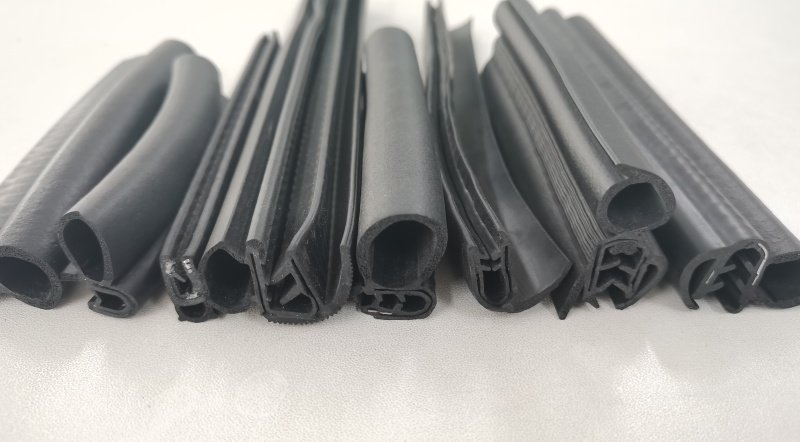
Rubber co-extrusion (mostly EPDM for pinch weld, auto seals)
Two or more rubber compounds (different hardness: dense rubber + sponge rubber / hard rubber substrate + soft sealing lip) are extruded together through one die.
Critical step: Vulcanization (curing) after exiting the die (hot air / steam oven). Crosslinking happens during vulcanization to lock elastic properties.
After vulcanization, it cannot be re-melted.
Bonding between layers forms during vulcanization; good interlayer adhesion when formula matched.
PVC co-extrusion (soft PVC + rigid PVC)
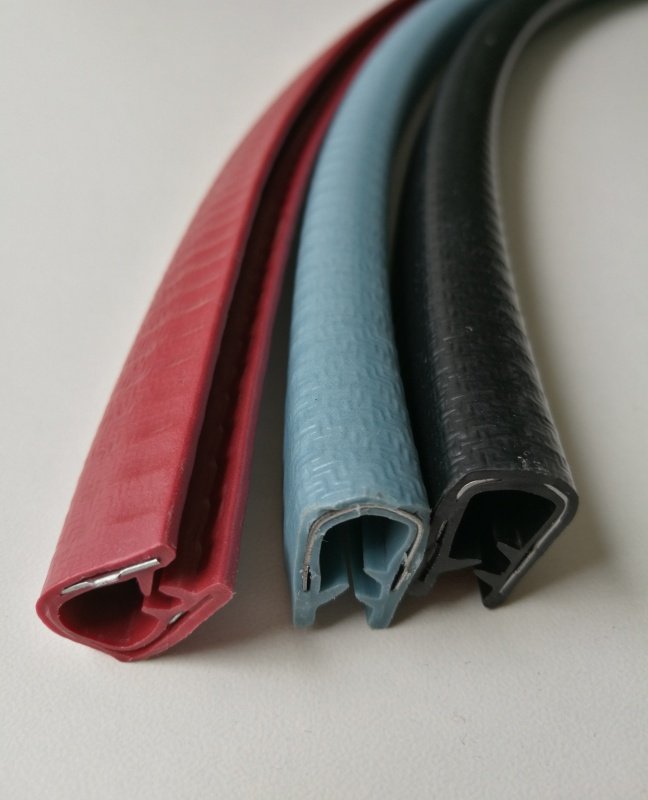
Rigid PVC (hard carrier/clip base) and plasticized soft PVC (sealing lip) are melted and co-extruded from separate extruders into one die.
No vulcanization. Simply cool down to solidify.
Thermoplastic: can be re-melted and recycled.
Fusion bonding at melt state before cooling; relies on melt compatibility of PVC formulations.
2. Material & Physical Properties
| Item | Rubber Co-extrusion (EPDM typical) | PVC Co-extrusion |
| Elasticity & compression set | Excellent rebound, low compression set. After squeezing, it quickly returns to original shape. Perfect for dynamic sealing | Good flexibility but poor long-term rebound. Plasticizer will migrate over time; permanent compression deformation easily occurs |
| Temperature range | ~ -40°C ~ +120°C | ~ -20°C ~ +70°C; becomes stiff/brittle in cold weather |
| Weather / ozone / UV | Outstanding (EPDM). Long service life outdoors, automotive under-body, wheel arch, pinch weld | Moderate. UV will cause chalking, aging; plasticizer leaching over years |
| Chemical resistance | Good resistance to water, ozone, road salt; EPDM poor to oil; NBR good for oil | Resist acid/alkali; poor resistance to oil, solvents |
| Hardness tuning | Wide range, dual-hardness rubber-rubber coextrusion | Soft/hard PVC combination; softness limited by plasticizer |
3. Cost & Production
Rubber co-extrusion: Higher raw material + higher production cost (long vulcanization oven, slower line speed). Higher tooling cost.
PVC co-extrusion: Cheaper raw material, faster line speed, simpler equipment, lower overall cost. Easier color matching.
4. Typical Applications
Rubber co-extrusion
Automotive pinch weld protector, car door/trunk seals, engine compartment seals, heavy machinery, outdoor long-life weather seals, trailer hatch gaskets.
Fits your previous rubber pinch weld profile — the U-shaped pinch weld rubber is commonly EPDM co-extruded (hard gripping base + soft sealing edge).
PVC co-extrusion
Building door/window seals, furniture edge trim, refrigerator door gaskets, indoor edge protection, low-cost static sealing, cabinet edge trim. Not recommended for long-life automotive outdoor exposure.
5. Main Limitations
Rubber: Cannot be recycled; longer production cycle; higher price.
PVC: Plasticizer migration (hardens over time); bad low-temperature performance; poor long-term dynamic sealing; not suitable for high-temperature environment.