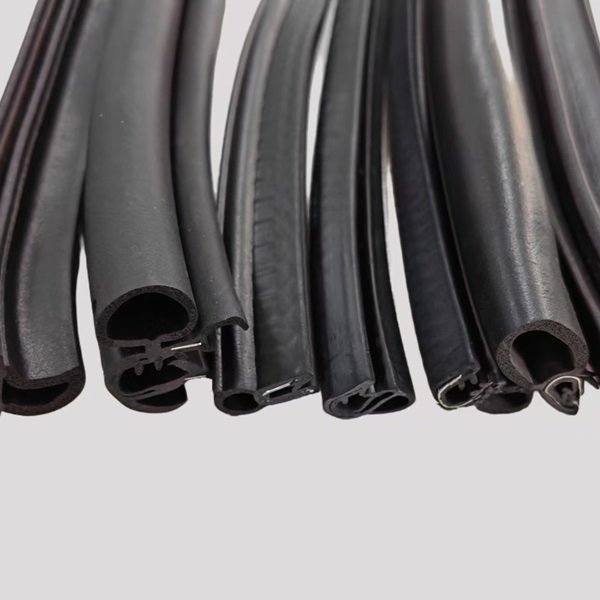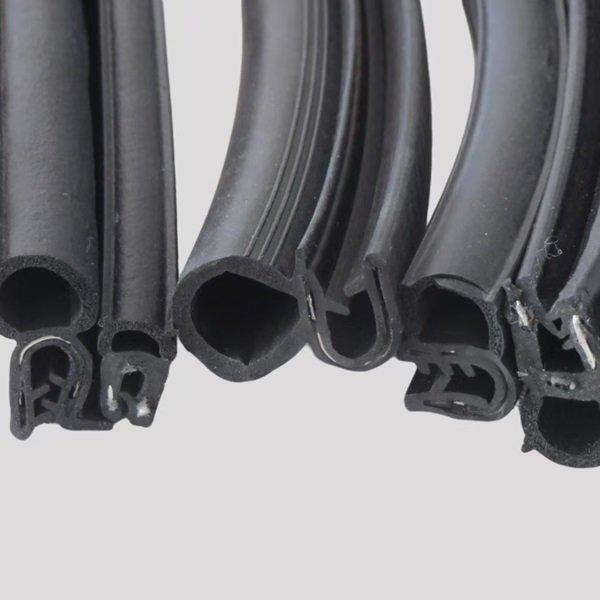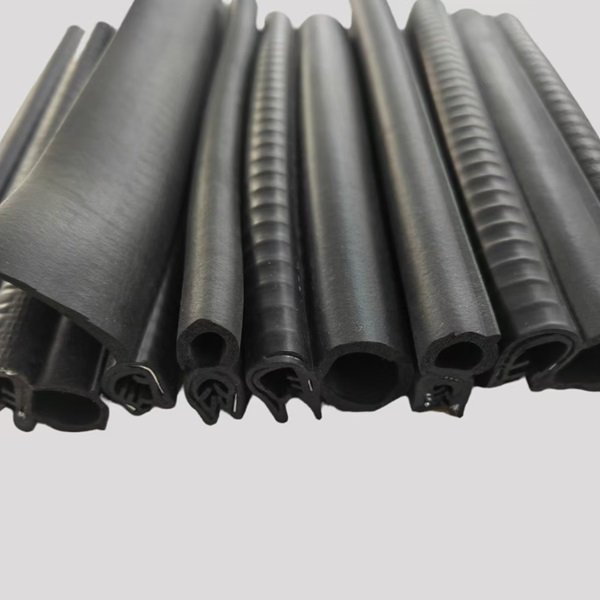

A rubber pinch weld seal is a U-profile rubber extrusion that clamps onto the welded flange where two sheet-metal panels meet. One part does three jobs at once: it covers a sharp edge, seals the joint against water, air and dust, and damps the vibration and noise that travel through the body. Todo Rubber extrudes these profiles in EPDM, NBR, PVC and silicone, in stock sections and to custom drawings.
What Is a Rubber Pinch Weld Seal?
A pinch weld is the flange formed where two panels are joined — spot-welded body seams, door frames, hood and trunk lips, cabinet edges, metal and glass panel rims. That flange is thin, sharp and often exposed.
A rubber pinch weld seal is the trim that grips it. The U-shaped channel is pushed over the flange, and the ribs inside the channel close on the metal so the profile stays put without adhesive. The outer wall takes the impact, the sealing lip or bulb closes the gap to the mating panel, and the rubber body absorbs movement instead of transferring it.
How a Pinch Weld Seal Works
Three mechanisms run at the same time:
Mechanical retention — the channel opening is sized slightly under the flange thickness, so the inner ribs compress and hold. No clamp, no tape, no rivet.
Sealing — a bulb, flap or lip deforms against the adjacent panel. The seal is made by elastic recovery, which is why it keeps closing after thousands of door cycles.
Cushioning — the profile wall is the bumper. Impact energy is absorbed as deformation and released as recovery rather than passed into the panel.
Construction and Materials
A typical profile is a single rubber extrusion with a U-channel body, ribbed inner walls, and an optional bulb or flap. Where extra stiffness or push-back force is needed, a steel wire carrier or textile cord is embedded during extrusion. Grooves and ribs on the outer face improve grip and help the profile seat evenly around curves.
Material choice does most of the work:
EPDM — the default for exterior and automotive use. Excellent ozone, UV and weathering resistance, −40 to +120 °C.
NBR — where oil, fuel or grease contact is expected.
PVC — low cost, wide colour range, good for interior trim, appliances and cabinets.
Silicone — high and low temperature extremes, plus medical and food-contact requirements.
Rubber Pinch Weld vs. Rubber Seal Strip
Both seal. They are built for different mounting conditions, and choosing the wrong one is the most common specification error.
If the surface you are sealing is an edge with thickness, you need a pinch weld profile. If it is a flat face with a gap to close, a seal strip is the cheaper answer.
Profile Types We Extrude
Pinch Weld Edge Protector
A plain U-section with no bulb. It covers the flange, removes the sharp edge, and takes abrasion and impact. The lowest-cost way to protect sheet metal, glass and composite rims. [See the edge protector range →]
U-Section Bulb Trim
A U-channel with a hollow bulb on the outer face. The channel holds the flange; the bulb compresses against the mating panel and provides both the seal and the cushion. Standard for automotive doors, hoods and hatches.
Flap Door Seal
A U-channel with an extended flexible flap instead of a bulb. The flap wipes across the gap and tolerates larger or less consistent build variation, which makes it forgiving on older body tooling and on industrial enclosures.
Boot and Trunk Seal
A heavier section with a larger bulb, sized for the wider gaps and higher closing forces at trunk, tailgate and boot openings.
Adhesive-Backed Edge Trim
A U-section with a pre-applied adhesive layer inside the channel, for edges that cannot be gripped mechanically — thin foils, plastic panels, retrofits and aftermarket fitting.
Applications: Where Rubber Pinch Weld Seals Are Used
Automotive Body, Door and Hood Sealing
Pinch weld trims run along door frames, window openings, hood and trunk lips. They protect the painted edge from chips and corrosion, close the gap against water and road noise, and stop the door from rattling against the body. Because the profile grips mechanically, it survives the closing force of thousands of cycles without working loose.
Edge Protection on Metal, Glass and Composite Panels
Any exposed panel rim is both a damage risk and a safety risk. Sheet metal edges cut; glass edges chip; composite edges fray. A pinch weld protector gives a robust barrier against impact and abrasion, and removes the sharp contact point for anyone handling the part. Common in automotive plants, metal fabrication, glass processing and construction.
Vibration Damping and Shock Absorption
Vibration shortens equipment life and adds cost. It accelerates wear, which means more repairs and more downtime. In vehicles it reaches the cabin as discomfort; in factories it degrades machine accuracy; in buildings it shows up as noise from HVAC plant.
A pinch weld seal absorbs and spreads that motion. Because rubber is elastic, it deforms under load, converts the energy and recovers — and it keeps recovering after repeated hits. Mounted between two surfaces, it damps vibration before it transmits, extends service life and reduces repair cost.
Waterproofing, Dust Sealing and Air Barriers
Water ingress is the quiet failure mode. It corrodes metal, shorts electrics and destroys bearings, and the repair bill arrives long after the cause. Dust does the same damage more slowly, and in food, electronics and pharmaceutical production it is a quality issue as well as a maintenance one.
The pinch weld form handles both. The channel covers the edge completely, the sealing element closes the gap, and the flexible body conforms over rough or irregular surfaces instead of leaving a path through. That is why the same profile protects engine bays, outdoor cabinets, control enclosures and cleanroom equipment.
Acoustic and Thermal Insulation
Rubber profiles trap air in a closed cell structure, and still air conducts heat poorly. The trapped pockets slow heat transfer across the joint, while the rubber body absorbs sound energy and breaks the direct path between panels. Used together with an acoustic barrier, a pinch weld trim reduces both drumming noise and heat loss at the same seam. Installers choose closed-cell grades where moisture is present, since open-cell foam loses insulating value once wet.
Grip, Handling and Operator Safety
The ribbed outer surface gives a firm, non-slip grip. On heavy sheet metal, glass panels and machined parts, that makes handling safer and reduces the chance of a part slipping out of a glove or clamp. This is a secondary benefit rather than a design driver, but on manual handling lines it is a real one.
Building, Appliance and Industrial Equipment
The same profiles close gaps on window and door frames, cabinet edges, machine guards, control panels, appliance housings and HVAC enclosures. Interior applications usually take PVC or a softer compound; exterior and wet applications take EPDM.
Material Selection: EPDM, NBR, PVC or Silicone
Match the compound to the environment, not to the drawing you already have. See the selection matrix above; the short version:
Outdoors, UV, rain, ozone → EPDM
Oil, fuel, grease contact → NBR
Interior, colour-matched, cost-sensitive → PVC
Extreme temperature or medical/food contact → silicone
How to Specify a Pinch Weld Seal
Send these six values and a profile can be quoted immediately:
Flange thickness the channel must grip — 0.5–4 mm is our standard band; state the tolerance.
Gap to be sealed, and how much the gap varies in production.
Movement and closing force — door slam energy, panel flex, joint movement.
Environment — indoor or outdoor, temperature range, oil or chemical exposure, washdown.
Retention method — mechanical grip or adhesive, and whether the profile must be removable for service.
Finish and colour, plus cut length, corner splicing and packaging for your line
Custom Profiles, Tooling and Sampling
Stock sections cover the common flange thicknesses and gap sizes. Beyond that, we extrude to drawing: channel depth and opening, bulb diameter and wall thickness, hardness in two zones (firm body, soft sealing lip), carrier insert, colour and surface finish.
The process is straightforward: send a drawing or a cut section of the existing part, we confirm the compound and die, run samples for fit and compression testing on your actual flange, and release production after approval. [Confirm die lead time and sample turnaround with the plant.]
Quality Control and Testing
Each production lot is checked for dimensional accuracy against the approved drawing, hardness, and visual defects. On request we can supply test data for ozone resistance, low-temperature flex, compression set, salt spray and flammability, depending on the compound specified. [List only the tests you actually run.]
Frequently Asked Questions
What is a pinch weld, exactly?
The pinch weld is the flange created where two panels are joined — typically a spot-welded body seam, a folded sheet-metal edge or a panel rim. A pinch weld seal is the rubber trim that grips that flange.
Is a pinch weld seal the same as weatherstripping?
Related, not identical. Weatherstripping is a general term for any gap seal on a door or window. A pinch weld seal is a specific construction: a U-channel that grips a flange. Many automotive weatherstrips are pinch weld profiles, but not all weatherstripping is.
Can it seal a 1 mm sheet-metal edge?
Yes. Our standard channel range starts at 0.5 mm flange thickness. Very thin or soft edges may need an adhesive-backed version instead of mechanical grip — tell us the material and we will specify accordingly.
Does it need adhesive to stay on?
No, for mechanical-grip profiles. The inner ribs are sized under the flange thickness so the rubber holds by compression. Adhesive is used only where the edge cannot be gripped, or where the profile must be fixed against sliding.
Will it fit around curves and corners?
Yes. The profile is flexible along its length and seats around radii; pre-formed or spliced corner pieces are available for tight 90° turns.
What temperatures can it handle?
−40 to +120 °C for EPDM, −30 to +100 °C for NBR, −20 to +70 °C for PVC, and −50 to +200 °C for silicone.
Can you extrude a custom profile?
Yes. Send a drawing or a cross-section sample with the flange thickness and gap dimensions.
Request a Quote or Free Samples
Todo Rubber is a manufacturer of rubber pinch weld seals, edge protectors and weatherstrip trims. Send us your flange thickness, gap size, operating environment and annual volume, and we will propose a profile, compound and retention method — with sample lengths for fit testing on your own parts.