
1. Introduction to EPDM Rubber Extrusion
EPDM rubber extrusion is a high-efficiency continuous manufacturing process that produces consistent cross-section rubber profiles for industrial sealing, weather protection, vibration cushioning, thermal insulation and edge protection. EPDM (Ethylene Propylene Diene Monomer) is a premium synthetic elastomer renowned for outstanding resistance to UV radiation, ozone, water, moisture and extreme temperature changes. This unique performance makes custom EPDM extruded profiles the top choice for long-lasting indoor and outdoor sealing solutions across global industrial markets.
Unlike traditional molded rubber parts with limited production length, EPDM rubber extrusion supports unlimited continuous production with precise, stable dimensional consistency. We offer fully customizable extruded EPDM profiles with adjustable shapes, hardness and surface treatments, catering to diverse OEM and industrial application needs in automotive, construction, HVAC, home appliances and mechanical equipment industries.
2. Complete Working Process of EPDM Rubber Extrusion
EPDM rubber extrusion adopts a standardized, precision-controlled production workflow, covering EPDM compound preparation, rubber conditioning, die shaping, continuous vulcanization curing, cooling and post-finishing. Strict parameter calibration is implemented in every production step, ensuring consistent mechanical performance, stable dimensions and flawless surface quality for all finished extruded EPDM seals and profiles.
2.1 EPDM Compound Preparation
The entire extrusion process begins with customized EPDM compound formulation. High-quality EPDM polymer is uniformly blended with premium additives, including curing agents, reinforcing fillers, color pigments and processing aids. We finely adjust the formula ratio to tailor key product properties such as hardness, flexibility, tensile strength, compression resistance and weather adaptability, matching diverse application scenarios from soft gap flexible sealing to heavy-duty mechanical protection.
2.2 Rubber Feeding and Conditioning
The fully mixed EPDM compound is fed into a professional cold-feed extruder. A precision rotating screw pushes and conditions the rubber under constant pressure and stable temperature, achieving uniform material softening and stable fluidity before extrusion. Strict control of temperature, pressure and feeding speed eliminates common defects such as dimensional deviation, surface bubbles and uneven texture, guaranteeing high-quality finished EPDM extrusion profiles.
2.3 Precision Die Shaping
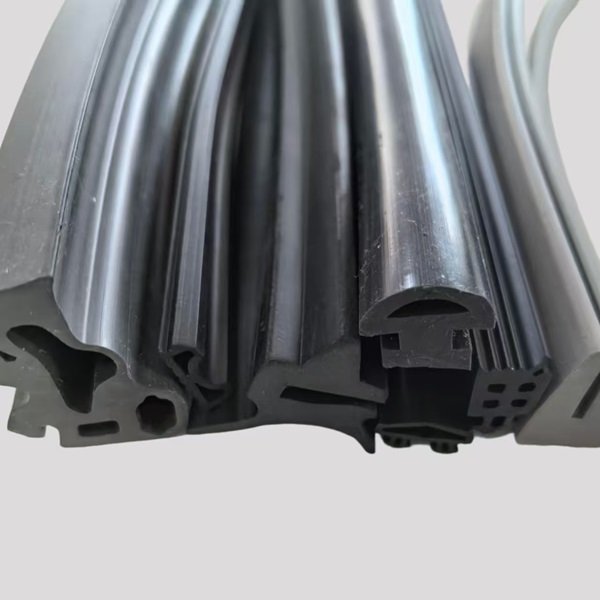
After professional conditioning, the fluid EPDM rubber is extruded through custom precision dies. The die opening defines the profile’s cross-sectional shape, enabling mass production of both regular and complex structural profiles. Common EPDM extrusion types include D-profiles, P-profiles, U-channels, L-angle strips, rectangular seals, hollow tubes and bulb weatherstripping. All dies are custom manufactured according to customer drawings, samples and installation groove dimensions to achieve perfect assembly fitting.
2.4 Professional Vulcanization & Curing
Extruded EPDM profiles are soft and uncured after exiting the die, requiring professional continuous vulcanization to form stable physical and mechanical properties. We deploy three mature curing technologies: hot air vulcanization, microwave vulcanization and advanced salt bath vulcanization (LCM). The oxygen-free, constant-temperature curing environment enables uniform cross-linking across the entire rubber cross-section, effectively enhancing elasticity, structural stability and low compression set performance. This precise curing process prevents premature aging, deformation and leakage caused by insufficient or over-curing.
2.5 Cooling, Cutting and Finishing Processing
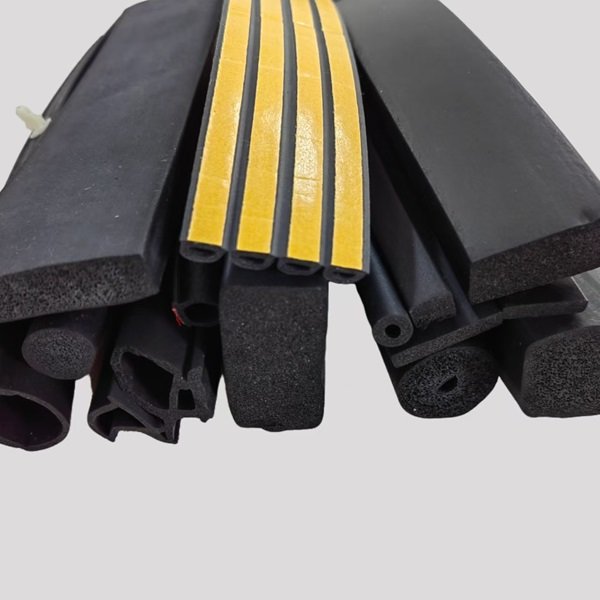
Post-vulcanization, EPDM profiles undergo gradual cooling and shaping to fix stable dimensions. Finished products are available in continuous coils or custom cut lengths to meet different packaging and installation requirements. We also provide comprehensive post-finishing services, including self-adhesive backing, punching, splicing, surface treatment and frame assembly. Every batch of EPDM extruded profiles is strictly inspected for dimension accuracy, hardness consistency, surface smoothness and compression performance before final delivery.
3. Two Main Types of EPDM Extrusion Profiles: Solid vs Sponge
Our custom EPDM rubber extrusion products are categorized into two core types: solid EPDM and sponge EPDM profiles. Both types feature unique structural advantages and performance characteristics, designed to fit different industrial sealing and protection working conditions.
3.1 Solid EPDM Extrusion
Solid EPDM extruded profiles adopt a dense, uniform rubber structure, delivering high mechanical strength, superior abrasion resistance and strong impact resistance. They maintain stable structural rigidity and original shape under long-term mechanical pressure and friction, ideal for applications requiring structural support and durable physical protection. Typical products include U-channels, rubber angle strips, glazing profiles and heavy-duty industrial equipment sealing strips.
3.2 Sponge EPDM Extrusion
Sponge EPDM extrusion features a fine uniform cellular internal structure, offering ultra-soft texture, high compressibility and excellent resilience. It can tightly fit irregular assembly gaps under low closing pressure, effectively isolating water, air, dust and external noise. It is the optimal flexible sealing solution for door and window weatherstripping, cabinet gaskets, equipment enclosure seals and HVAC system gap sealing scenarios.
Additionally, we support professional solid-sponge co-extrusion technology, which integrates the structural rigidity of solid EPDM and the flexible sealing performance of sponge EPDM into a single integrated profile, meeting high-standard comprehensive sealing requirements for complex industrial equipment.
4. Core Advantages of EPDM Extruded Seals
EPDM stands out as the most reliable material for extruded continuous sealing profiles, boasting comprehensive and irreplaceable performance advantages for industrial applications:
Excellent UV and ozone resistance, suitable for long-term outdoor exposure
Superior weather and temperature aging resistance, adapting to extreme temperature changes
Good waterproof, moisture-proof and steam resistance
Low compression set, stable sealing performance for long service life
Customizable hardness, color and shape, strong scene adaptability
Smooth surface, no burrs, no leakage after installation
Important Note: EPDM rubber profiles are not suitable for long-term exposure to petroleum oils, gasoline and hydrocarbon fuels. For oil-resistant sealing applications, our custom NBR rubber extrusion profiles are the ideal alternative solution.
5. Wide Industrial Applications of EPDM Rubber Extrusion
5.1 Automotive Sealing Systems
Custom EPDM extruded weatherstripping is widely adopted in automotive sealing systems for doors, windows, trunks and hoods. These high-performance profiles effectively block external rainwater, dust, airflow and road noise, significantly improving vehicle airtightness and driving comfort. With exceptional anti-aging and weather resistance, our automotive EPDM seals maintain stable sealing performance for over 10 years of vehicle service life.
5.2 Door & Window Construction Sealing
Extruded EPDM profiles are essential standard accessories for architectural doors, windows and curtain wall systems. They perfectly fill assembly gaps, reduce air convection and water penetration, and eliminate common problems such as air leakage, water seepage and indoor drafts. Featuring excellent UV and aging resistance, these building EPDM seals withstand long-term outdoor wind, rain and sun exposure without cracking or deformation.
5.3 Construction & Building Engineering
EPDM rubber extrusion profiles are widely used in building expansion joints, facade curtain walls, roofing systems and exterior wall gaps. They resist harsh outdoor weather erosion, maintain long-term airtight and waterproof performance of building structures, and effectively extend the overall service life of construction projects.
5.4 Industrial Machinery & Enclosure Equipment
Industrial machinery, electrical equipment and enclosures commonly adopt EPDM extruded seals for door panels, access openings and cabinet gaps. These profiles isolate external dust and moisture, reduce equipment operating vibration and buffer impact force, fully protecting internal electrical components and mechanical parts from environmental damage.
5.5 HVAC & Household Appliances
Soft sponge EPDM extrusion profiles are ideal for HVAC systems, refrigeration equipment and household appliances. They deliver reliable gap sealing, prevent air leakage, reduce operating vibration and lower noise. With low closing force and excellent gap adaptability, they fit irregular equipment gaps perfectly for stable long-term sealing performance.
6. Custom EPDM Extrusion Service
We provide professional one-stop custom EPDM rubber extrusion solutions for global OEM manufacturers and industrial clients. All extruded EPDM profiles can be fully customized based on your design drawings, physical samples and actual working condition requirements:
Custom solid/sponge structure and co-extruded composite structure
Custom Shore A hardness, color and overall dimensions
Adhesive backing, punching, cutting, splicing and other finishing processing
Support small-batch prototype customization and large-scale mass production
7. Conclusion
EPDM rubber extrusion is a mature, efficient and high-reliability manufacturing technology for continuous sealing profiles. Through standardized compound blending, precision extrusion molding and multi-mode professional vulcanization, we produce high-quality solid and sponge EPDM profiles with superior weather resistance, flexibility and dimensional stability. Widely applied in automotive, construction, industrial machinery and HVAC industries, custom EPDM extruded seals are the most cost-effective, durable solution for long-term indoor and outdoor industrial sealing projects.