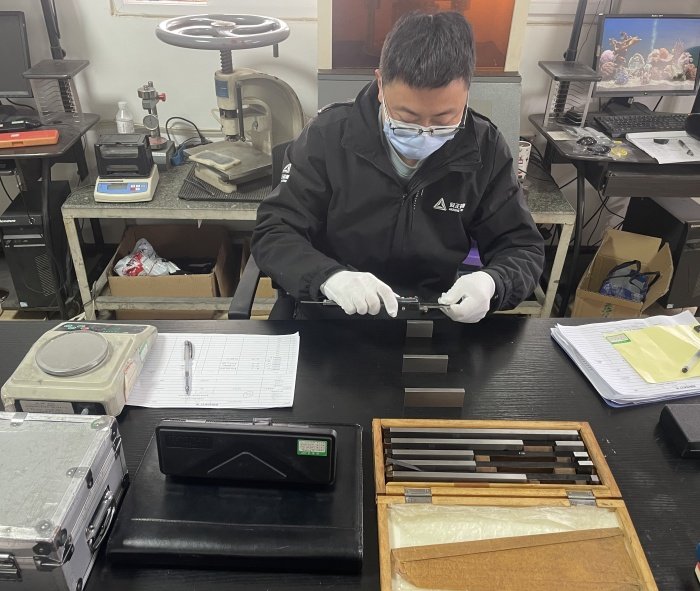

At the calibration site, technicians strictly followed national metrological verification regulations and industry standards, conducting meticulous, item-by-item inspections of key indicators such as indication error, repeatability, and stability of the measuring instruments.
Taking the calibration of vernier calipers as an example, technicians repeatedly verified multiple measurement points on the calipers using standard gauge blocks to ensure that the measurement accuracy was always kept within the tolerance range. For precision equipment such as hardness testers and electronic balances, comprehensive calibration and status confirmation were also completed in accordance with standardized procedures, leaving no detail that might affect test results unchecked.
The accuracy of measuring instruments is the "first line of defense" for product quality. Regular calibration not only helps detect and eliminate errors in measuring tools in a timely manner, avoiding product quality risks caused by measurement deviations, but also provides reliable data support for production process optimization and quality issue traceability. It is an important link in the company’s full-process quality control.
All along, the company has always regarded metrology management as a core component of its quality management system. By establishing a complete ledger of measuring instruments and implementing a management model that combines periodic calibration with routine maintenance, we ensure that every measuring instrument is under controlled status, safeguarding the continuous stability of product quality.
Going forward, the company will continue to strengthen metrology management, continuously improve the full life cycle control mechanism for measuring instruments, leverage precise metrology to drive product quality improvement, and deliver more reliable products to customers.